
There is something about a full moon that everyone feels, whether or not they believe in it. Sleep goes strange, emotions run close to the surface, and the sky looks impossible to ignore. For thousands of years people have organised planting, harvesting, festivals and prayer around that fourteen-night swell of light — and full moon rituals are simply the modern, personal version of that very old habit: pausing, taking stock, and letting something go.
This guide walks you through what the full moon is said to represent, a simple ritual you can do in about thirty minutes with things you already own, how to charge and cleanse your crystals in moonlight, and which stones are traditionally paired with this phase.
What the Full Moon Represents
The lunar cycle runs roughly 29.5 days. It opens with the new moon, when the moon sits between earth and sun and is invisible to us — the traditional moment for planting intentions. Over the next two weeks the light grows (the waxing phase, associated with building and effort) until the moon is fully lit and directly opposite the sun. That is the full moon: the peak, the harvest, the moment of maximum visibility.
Because it is the brightest point of the cycle, the full moon is believed to illuminate whatever we have been avoiding. In folk practice and modern astrology alike it is treated as a time of completion and release rather than beginning — you finish things under a full moon, you do not start them. It is also linked with the emotional, intuitive, receptive side of ourselves, which is why so many people report feeling unusually raw or wide awake around it.
Does the moon actually change your mood? Research on that is mixed and mostly inconclusive; some sleep studies find people take slightly longer to fall asleep around a full moon, others find nothing at all. What is not in doubt is the value of a monthly ritual that makes you sit down and think about what is working in your life. Consider the moon the timekeeper, and the ritual the useful part.
Before You Begin: Three Small Preparations
- Check the date. A full moon is exact to the minute, but the energy is traditionally considered available for about three days — the night before, the night of, and the night after. If you miss the exact evening, you have not missed the window.
- Clear your space. Tidy the room you will use, even roughly. Many people also cleanse the air with sage or another smoke cleanse, open a window, or simply light a candle. The point is a physical signal that this half hour is different from the rest of the evening.
- Gather what you need. A candle, a notebook and pen, a bowl of water or a small dish of salt, and one to three crystals. Nothing here needs to be expensive or new.

A Simple 30-Minute Full Moon Ritual
This is a release ritual — the traditional use of the full moon. Read it through once, then do it in your own words. Ritual done awkwardly and honestly beats ritual done perfectly from a script.
1. Sit and settle (5 minutes)
Turn off overhead lights, light your candle, and sit somewhere you can see the moon if the sky is clear. Breathe slowly — in for four counts, out for six — until your shoulders drop. Hold a crystal in your left hand if you have one nearby.
2. Take stock (5 minutes)
Ask yourself what has actually happened since the last new moon. What finished? What went well that you never acknowledged? Full moons are harvest moons; before you release anything, name what you have already gathered.
3. Write what you are releasing (10 minutes)
On one page, write the things you are ready to put down. Be specific: not “stress” but “saying yes to work I do not want on Sunday nights.” Resentments, habits, an old story about yourself, a relationship that ended months ago in everything but name. Write until the page feels finished rather than until it is full.
4. Let it go
Traditionally the page is burned — safely, in a fireproof dish or over a sink, or outdoors. If burning is not sensible where you live, tear the page into small pieces and bin or compost it, or run it under water until the ink blurs. Say something out loud as you do it, even one sentence: I am done carrying this.
5. Fill the space (5 minutes)
Release leaves a gap, so close by naming what you want in its place — on a second page you keep. Place your crystals on top of it, blow out the candle, and go to bed early if you can. Many people find the day after a full moon ritual is the one where something actually shifts.

Charging and Cleansing Crystals in Full Moonlight
This is the most popular full moon practice of all, and the easiest. Moonlight is considered a gentle, universally safe cleanse — unlike sunlight, which fades amethyst, rose quartz, citrine and fluorite, or water, which damages softer and metallic stones such as selenite, lapis lazuli and malachite.
- Wipe each stone with a dry cloth to remove dust.
- Set them on a windowsill, balcony, or outside on a plate or cloth where moonlight reaches — a windowsill through glass is fine, and cloud cover does not matter to most practitioners.
- Leave them out overnight, ideally from moonrise to just after dawn.
- Bring them in before the day gets bright if you own sun-sensitive stones.
- Hold each one for a moment as you collect it and set your intention for the coming month.
If you would rather not leave crystals outdoors, a selenite plate or charging bowl indoors is the usual alternative, and works in any weather. For the full range of methods, see our guide to how healing crystals are believed to work.
The Best Crystals for Full Moon Rituals
Moonstone
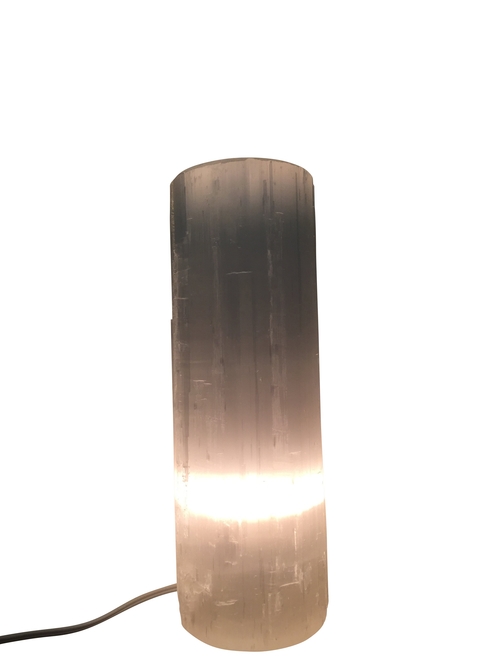
Moonstone is the obvious companion — named for the moon, associated with cycles, intuition and emotional steadiness. Hold it during the settling and writing stages, or sleep with it beside the bed on full moon night.
Selenite
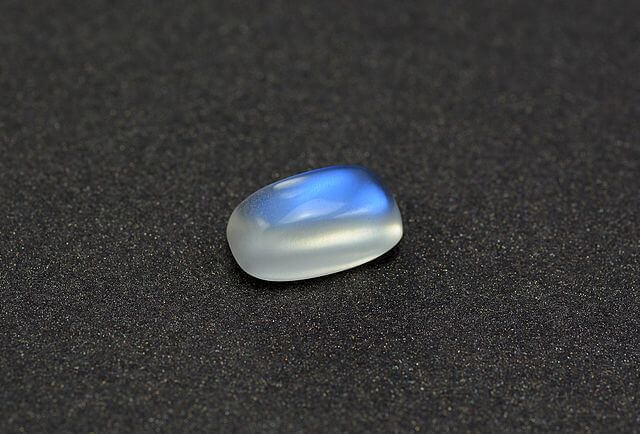
Named after Selene, the Greek goddess of the moon. Selenite is used for clearing a space before ritual and for cleansing every other stone afterwards. Keep it dry — it dissolves in water.
Clear quartz
Clear quartz is the amplifier: placed at the centre of a grid or beside your intention page, it is believed to strengthen whatever else is present. If you own one crystal, this is the flexible one.

Amethyst
Amethyst is the calming stone of the group — traditionally used for intuition, dream work and the restless sleep many people report around a full moon.
Labradorite
Labradorite flashes blue and gold as it catches the light, and is associated with transformation and protection during change — a good stone for a release ritual that feels a bit daunting.
Black tourmaline or smoky quartz
Both are grounding stones. If full moons leave you wired or over-emotional, hold smoky quartz at the end of your ritual to feel back in your body.
Rose quartz
Rose quartz belongs in any ritual where you are letting go of something you loved. Pair it with the release stage, and with our guide to crystals for self-love.
Five More Full Moon Rituals to Try
- Moon water. Fill a clean, covered jar with water and leave it in moonlight overnight. Use it to water plants, add it to a bath, or cleanse your altar. Do not drink water that crystals have soaked in.
- A full moon bath. Warm water, epsom salt, a few drops of lavender, candles, and your stones on the edge of the tub rather than in the water.
- A gratitude list. Ten things from the past month, written fast, no editing. This is the harvest half of the full moon and the one people skip.
- A crystal grid. A central clear quartz point surrounded by six stones, built on top of your intention page. Leave it up until the new moon.
- A digital declutter. Unfollow, unsubscribe, delete the drafts you never sent. A remarkably satisfying modern release ritual.
Full Moon Ritual Mistakes to Avoid
- Setting new intentions instead of releasing. Save the fresh starts for the new moon — see our guide to crystals for new beginnings.
- Making it too big. An elaborate ceremony you do once beats nothing, but a simple one you repeat monthly is what actually changes things.
- Leaving sun-sensitive crystals out all day. Bring them in at dawn.
- Soaking the wrong stones. Selenite, malachite, lapis lazuli, pyrite and halite should never go in water.
- Expecting the moon to do the work. The ritual clarifies the decision; you still have to make it on Tuesday morning.
Frequently Asked Questions
When exactly should I do a full moon ritual?
The night of the full moon is traditional, but the three-day window around it — the night before, the night of, and the night after — is considered equally good. Do it when you actually have a quiet hour.
Do I need to see the moon?
No. Cloud, rain and city light are not considered barriers, and the practice works indoors. The moon is the calendar, not the ingredient.
How long should crystals sit in the moonlight?
Overnight is standard — roughly eight to twelve hours. There is no penalty for less; even an hour on a windowsill is used by many people as a quick reset.
Can I charge crystals through a window?
Yes. Glass is not believed to block moonlight’s effect, and it keeps your stones safe from rain, wind and curious animals.
Is moon water safe to drink?
Plain water left in a sealed, clean jar is water. Water that crystals have been sitting in is not recommended for drinking — several popular stones contain copper, aluminium or lead compounds. Use the indirect method instead: a sealed vial or a glass of water placed beside the crystals.
What if I miss a full moon?
Nothing is lost. There is another one in 29.5 days, and the practice is meant to be forgiving. Many people simply do their release ritual on the next quiet evening.
Do I have to burn what I write?
No — and please do not if you cannot do it safely. Tearing, composting or running the page under water are all used as equivalents.
A Ritual Worth Keeping
Full moon rituals endure because they answer a very practical need: a regular, non-negotiable appointment with yourself. Light a candle, hold a stone, write down what you are ready to stop carrying, and let the brightest night of the month give you an excuse to be honest. New to any of this? Start with how to start a crystal collection and build from there.
Crystal healing is a traditional and spiritual practice, not a medical one. Nothing here is intended as medical or psychological advice, and crystals should never replace care from a qualified professional.
Comments are closed.