It is the question everyone asks sooner or later, usually while holding a piece of rose quartz and feeling slightly silly: do healing crystals actually work? You deserve a straight answer, not a sales pitch. So here it is, in the warm-but-honest Zenluma way: there is no scientific evidence that crystals emit healing energy or treat illness. But there is good reason to believe that using crystals can make people feel calmer, more focused and more intentional, and that is not nothing.
This guide looks at the question from both sides: what the research says, what the tradition says, and how to use crystals in a way that is grounded, safe and genuinely beneficial. If you want the theory behind crystal energy, vibration and chakras, read our companion piece How Do Healing Crystals Work?. This article is about the evidence and the real-world benefits.

The Short Answer
- As medicine: no. No controlled study has shown crystals cure, treat or prevent any disease.
- As a tool for mindfulness and intention: many people find them genuinely helpful, and there are plausible psychological reasons why.
- As a tradition: crystals have been treasured, carried and used in ritual for thousands of years across cultures, and that meaning is real to the people who practise it.
- As a risk: crystals themselves are harmless. The only real danger is using them instead of medical care.
What the Research Actually Says
Very little formal research has been done on crystal healing, which is itself telling. The best-known study was run by psychologist Christopher French and colleagues at Goldsmiths, University of London, and presented to the British Psychological Society in 2001. Volunteers meditated while holding either a real quartz crystal or a convincing glass fake, after being told what sensations they might feel.
The result: people reported tingling, warmth and a sense of wellbeing at almost identical rates whether they held a real crystal or a fake. What predicted the experience was not the stone, but the person’s expectations and beliefs. In other words, the effect was real to the participants, but it came from the mind rather than the mineral.
That is often summarised as “it’s just placebo.” We think that framing undersells what is going on. Expectation, ritual and attention are powerful forces. They shape how we feel, how we breathe and how we respond to stress, and they are the same mechanisms that make meditation, prayer and journaling worthwhile for so many people.
What about piezoelectricity?
You will often read that quartz “generates energy” because it is piezoelectric. Quartz really does produce a tiny electrical charge when squeezed, which is why it keeps time in watches and electronics. But that charge only appears under mechanical stress inside a circuit. A crystal resting in your palm or on your nightstand is not producing anything your body can detect, so piezoelectricity is a fascinating fact about quartz, not proof of healing.

Why Crystals Can Still Help: Five Grounded Benefits
1. They anchor a moment of mindfulness
Holding a smooth, cool stone gives your attention somewhere to land. Many people use a crystal as a focal point for a few slow breaths, which is a simple, well-supported way to calm the nervous system. Our chakra meditation guide builds on exactly this idea.
2. They act as a cue for a habit
Behaviour scientists talk about “cues” that trigger routines. A piece of amethyst by your bed can become the cue for putting your phone away; a tiger’s eye on your desk can become the cue to start your hardest task. The stone works because you attached a meaning and a habit to it. See crystals for sleep and crystals for focus for routines built this way.
3. They make intentions tangible
Writing an intention and placing a stone on it sounds simple, but turning a vague wish into a physical object you see every day keeps the goal in front of you. That is the practical heart of crystal manifesting: clarity plus repeated reminders plus action.
4. They connect you to beauty and the natural world
Crystals are tiny pieces of geological history, formed over thousands to millions of years. Pausing to appreciate something that old and that beautiful is a genuine mood lift, in the same way a walk in nature or a vase of flowers can be.
5. They carry personal and cultural meaning
A stone gifted by a loved one, worn through a hard season, or chosen for its traditional symbolism can be deeply comforting. Meaning matters. Our guide to crystals for grief explores how people use stones to hold memories.
What Tradition Says
Across history, crystals have been used for protection, status and ritual. Ancient Egyptians placed carnelian, lapis lazuli and turquoise in amulets and burial goods. Roman writers such as Pliny the Elder recorded beliefs about amethyst and bloodstone. Traditional Chinese culture has prized jade for millennia as a symbol of virtue and longevity, and Ayurvedic tradition links gemstones to the planets. Modern crystal healing draws on these threads, along with the yogic idea of the seven chakras.
Practitioners believe each crystal carries a particular vibration or energy that can interact with the body’s energy field. This is a spiritual framework rather than a scientific one, and it can be honoured as such: you do not need to prove a belief in a lab for it to be meaningful in your life.
How to Use Crystals in a Grounded, Healthy Way
- Pick one clear purpose. Calm, focus, sleep, confidence. One stone, one intention is easier to stick with than a drawer full of rocks.
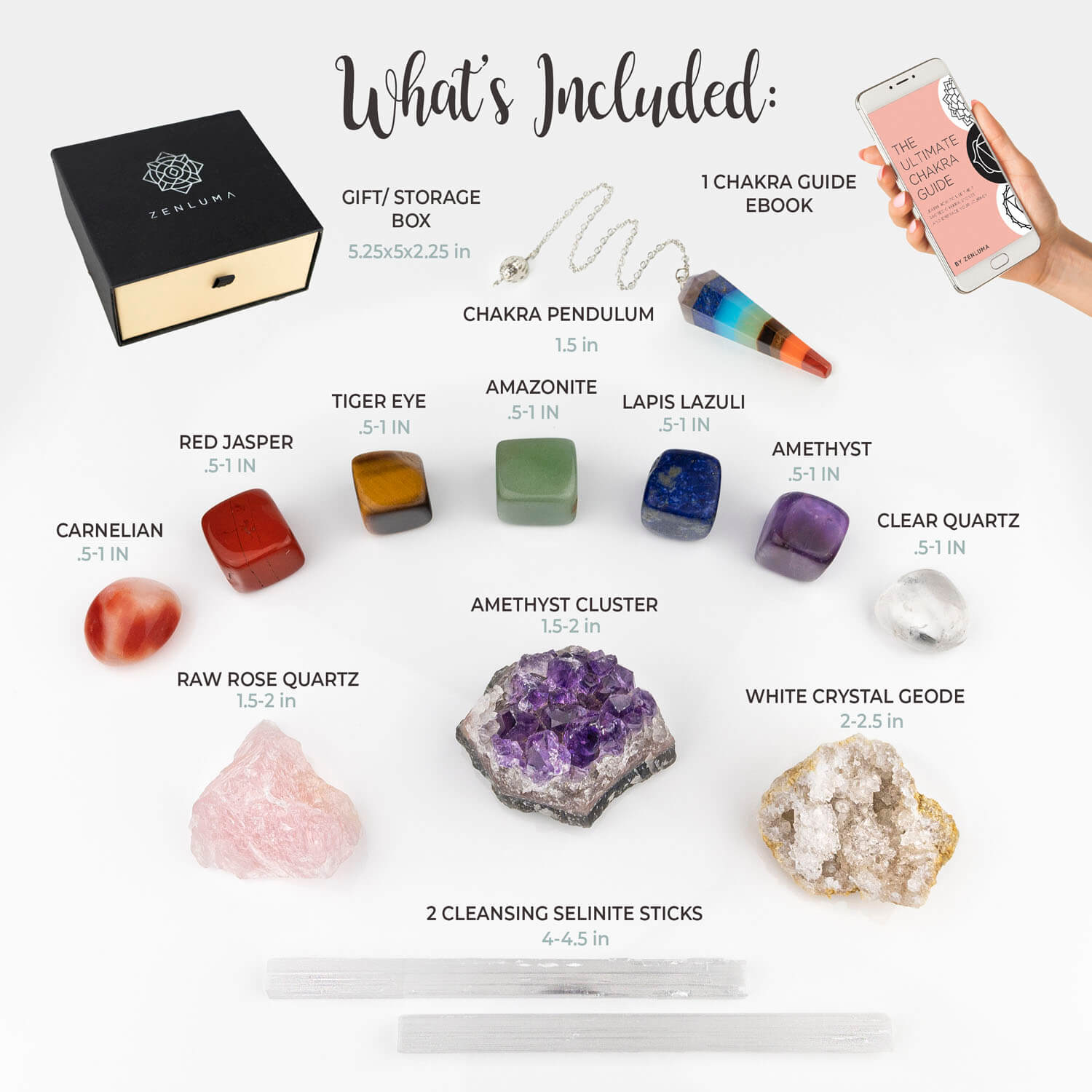
- Pair the stone with an action. Three slow breaths, a sentence in a journal, a walk. The crystal is the reminder; the action does the work. Try a few tumbled amethysts by the bed as a wind-down cue.
- Keep it short and daily. Two minutes every day beats an hour once a month.
- Look after your stones. Cleansing is a lovely reset ritual for you as much as the crystal. Our crystal cleansing guide lists which stones are water-safe.
- Notice honestly. After a few weeks, ask yourself whether the ritual helps. If it does, keep it. If not, change it. That is a healthy relationship with any wellness practice.

When Crystals Are Not Enough
Crystals can sit alongside care, never replace it. Please see a doctor or mental health professional if you are dealing with persistent pain, low mood that lasts more than a couple of weeks, panic attacks, ongoing insomnia, or any symptom that worries you. A good rule: use crystals for the things you would also use a candle, a bath or a meditation app for, and use professionals for everything else.
Be wary of anyone who sells a crystal as a cure, tells you to stop medication, or charges large sums for “energy-charged” stones. Genuine practitioners frame crystals as supportive, not curative.
Best Crystals to Start With
If you want to try crystals with an open, practical mindset, these classic stones are inexpensive, durable and rich in tradition:
- Clear quartz – the all-purpose “master healer”; see clear quartz meaning.
- Amethyst – traditionally linked to calm and restful sleep; see amethyst meaning.
- Rose quartz – the stone of love and self-compassion; see rose quartz meaning.
- Black tourmaline – a favourite protective and grounding stone; see crystals for protection.
- Citrine – said to bring warmth, optimism and motivation; see citrine meaning.
New to all of this? Our crystals for beginners guide and how to start a crystal collection walk you through choosing and buying your first stones. You can also pick up a small starter trio without spending much.
Frequently Asked Questions
Is there scientific proof that healing crystals work?
No. The limited research available, including the 2001 Goldsmiths study, found that people experienced the same effects with real and fake crystals, which points to expectation rather than any property of the stone.
So is crystal healing just placebo?
Largely, from a scientific point of view. But placebo responses reflect real changes in how people feel, and the rituals around crystals (breathing, intention-setting, slowing down) have their own value.
Can crystals cure anxiety or depression?
No. They may be a comforting part of a self-care routine, as described in our crystals for anxiety guide, but anxiety and depression deserve proper support from a professional.
Are healing crystals dangerous?
The stones themselves are generally safe to handle. Avoid making gem elixirs with toxic minerals such as malachite, and never delay medical treatment in favour of crystals.
Do expensive crystals work better than cheap ones?
There is no evidence that price changes anything. Choose stones you find beautiful and meaningful; a small tumbled stone is just as useful as a large display piece for daily practice.
How do I know if crystals are working for me?
Keep a short note of how you feel before and after your crystal ritual for two or three weeks. If you feel calmer, more focused or more intentional, the practice is serving you.
Disclaimer: Crystal healing is a traditional and complementary practice. Nothing in this article is medical advice, and crystals should never replace diagnosis or treatment from a qualified healthcare professional.