Almost every crystal collection starts the same way: one stone, bought on impulse, that you couldn’t put down. Then a second. Then you’re standing in a shop working out whether you need a third piece of amethyst (you probably don’t) while the labradorite you actually wanted sits ignored.
This guide is the thing we wish someone had handed us at the start — how to choose your first crystals, how many you actually need, what to spend, where to buy, how to care for them, and how to build a collection that stays meaningful instead of becoming a drawer of forgotten rocks.
First, Decide Why You’re Collecting
There’s no wrong answer here, but knowing your reason will save you money. Most collections fall into one of three types:
- A practice collection — a small, deliberate set of stones you actually use for meditation, intention setting, or sleep. Five to ten pieces is plenty.
- An aesthetic collection — pieces chosen because they’re beautiful. Clusters, towers, and display specimens. Fewer, better pieces beat many small ones.
- A mineral collection — collecting by species, locality, and formation. This is where origin, quality, and labelling matter most.
Most people are a blend of the first two. If you’re mainly interested in the practice side, our guides to crystals for beginners and how to use healing crystals are the natural companions to this article.
The 7 Crystals To Start With
If you buy nothing else, buy these. Between them they cover grounding, calm, clarity, love, confidence, protection, and cleansing — which is nearly everything a beginner practice asks for. They’re also all common, affordable, and hard to fake convincingly.
1. Clear Quartz — The All-Rounder

Known as the “master healer”, clear quartz is used to amplify intention and to stand in for almost any other stone. If you own one crystal, own this. A small point or tumbled piece is inexpensive and endlessly useful.
2. Amethyst — Calm And Sleep

Purple, widely available, and beautiful in cluster form. Amethyst is traditionally associated with calm, clear thinking, and restful sleep — which is why it lives on so many bedside tables. See also crystals for sleep.
3. Rose Quartz — The Heart Stone
Soft pink and the gentlest stone in most collections. Rose quartz is the go-to for self-compassion, kindness, and love of all kinds. Excellent to hold when everything feels like too much.
4. Black Tourmaline — Protection
Black tourmaline is the standard protective stone, traditionally used to absorb and ground heavy energy. Most people keep a piece by the front door or on a desk near electronics.
5. Smoky Quartz — Grounding
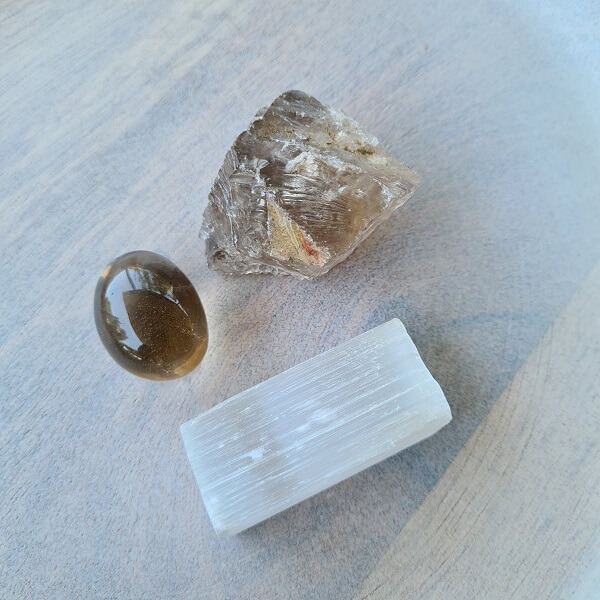
Smoky quartz is the steadying one — the stone people reach for when they feel scattered, anxious, or ungrounded. It’s a good pairing partner for anything intense.
6. Citrine — Confidence And Abundance
Sunny and warm, citrine is linked to confidence, creativity, and abundance. A note for beginners: much of the deep orange “citrine” sold cheaply is heat-treated amethyst. Natural citrine is a paler, softer yellow.
7. Selenite — Cleansing
Selenite does double duty: it’s used to clear stagnant energy in a room, and a selenite plate or bowl is the easiest way to cleanse the rest of your collection. Keep it dry — it dissolves in water.
A curated seven-stone starter kit usually covers most of the list in one purchase and costs far less than buying each stone individually. If you’d rather build slowly, buy one stone a month and actually use it before adding the next.
How Many Crystals Do You Actually Need?
Fewer than you think. A working practice collection of five to ten stones you know well is more useful than fifty you can’t identify. The most common beginner mistake isn’t buying the wrong crystal — it’s buying so many that none of them mean anything.
A good test: can you name every stone you own, and say why you bought it? If not, pause collecting and spend a month working with what you have.
Ten crystals you use beat a hundred in a drawer.
Choosing Shapes And Forms
The same mineral comes in many forms, and the form changes how you’ll use it:
- Tumbled stones — smooth, pocket-sized, cheapest. Best for carrying, holding, and grids. Start here.
- Points and towers — directional; traditionally used to focus energy. See are crystal points natural for how they’re made.
- Clusters and geodes — display pieces, used to fill a room rather than to carry.
- Spheres — associated with even, radiating energy. Beautiful, usually pricier.
- Palm stones — flat and shaped for the hand. Lovely for meditation.
- Wands — used in body work; see how to use a chakra wand.
- Jewellery — the most practical way to keep a stone with you all day.
Raw or polished is purely preference — we cover the trade-offs in rough vs tumbled crystals. Raw pieces show the mineral’s natural growth; tumbled pieces are more durable and pocket-friendly.
Where To Buy Crystals (And What To Watch For)
Buy from sellers who can tell you what a stone is and where it came from. That single filter removes most problems.
- Local rock and mineral shops — the best place to start, because you can handle stones and ask questions.
- Gem and mineral shows — great value and knowledgeable sellers.
- Reputable online sellers — look for photos of the exact piece you’ll receive, stated origin, size and weight, and a clear returns policy.
- Marketplaces — fine for common tumbled stones and starter sets; be more careful with expensive or rare species.
Red flags: prices far below the norm for a species, perfectly even banding or colour, suspiciously vivid dyed stones (bright blue “turquoise” howlite, neon “agate” slices), and vague listings that never name a locality. Common fakes to know about: dyed howlite sold as turquoise or lapis, glass sold as obsidian or opalite, resin sold as malachite, and heat-treated amethyst sold as natural citrine.
Our full guide to where to buy healing crystals goes deeper, including questions worth asking a seller about ethical sourcing.
What To Budget
Crystals span an enormous price range, and beginners rarely need the expensive end. Rough guidance:
- Tumbled stones: a few dollars each. Buy these freely.
- Small points, palm stones, small clusters: ten to thirty dollars.
- Starter kits of 6–8 stones: often the best value per stone.
- Statement clusters, towers, and spheres: fifty dollars and up, depending on species and size.
- Rare or fine specimens: hundreds. Learn first, buy later.
A sensible first budget is thirty to sixty dollars for a starter set plus one piece you simply love. Then stop and use them.
How To Care For Your Collection
Cleansing

Most traditions recommend cleansing a new crystal before you use it, then periodically after. Methods include smoke from sage or another herb, sound from a bell or singing bowl, moonlight overnight, a selenite plate, or dry salt (not the stone in salt water). Our complete crystal cleansing guide covers each one, and how to cleanse crystals without palo santo offers sustainable alternatives.
Important: not every crystal likes water or sun. Selenite, halite, and calcite dissolve or degrade in water. Malachite, pyrite, and hematite shouldn’t be soaked. Amethyst, rose quartz, citrine, fluorite, and aquamarine fade in prolonged direct sunlight. When in doubt, use a dry method.
Storing And Displaying
- Keep soft stones (malachite, selenite, fluorite, calcite) separate from harder quartz so they don’t get scratched.
- Line a shallow drawer or tray with felt, or use a divided box for tumbled stones.
- Keep display pieces out of long direct sun and away from radiators.
- Dust with a soft dry brush rather than a wet cloth.
- Label anything you might forget — a small note under each piece with its name and where you bought it is worth more than you’d expect in a year’s time.
Keep A Simple Log
A notebook or notes app entry per stone — what it is, where it came from, what you paid, and why you chose it — turns a pile of rocks into a collection with a story. It also stops you buying your fourth rose quartz.
How To Actually Use Your Collection
This is where most collections stall. Pick one or two of these and keep them simple:
- Carry one stone a day. Choose it in the morning based on what the day needs. Simple, and it teaches you what each stone feels like.
- Meditate with a single crystal. Hold it, breathe, five minutes. Our guide to meditating with crystals has a full walkthrough.
- Set an intention. Intention setting with crystals gives your practice a focus beyond collecting.
- Build a small grid. Six stones and a centre point is enough — see the beginner’s crystal grid guide.
- Place stones around your home. Bedside, desk, entryway. See best crystals for your workspace and our guide to clearing negative energy at home.
- Work with your chakras. If that’s your interest, what order do chakra stones go in is the practical starting point.

Growing Your Collection With Intention
Once you have the basics, the most satisfying way to expand is by theme rather than by impulse. A few directions worth following:
- Your birth sign — start with your sun sign and the matching zodiac crystal guide, then add your moon sign and rising sign stones.
- A chakra set — seven stones, one per centre. See the 7 chakras.
- A goal — confidence, focus, prosperity, or new beginnings.
- A colour family — for example green healing stones for heart-centred work.
- Moon work — see crystals for moon phases and full moon rituals.
And if you want the classics before the curiosities, our top 10 healing crystals list is a reliable map. A tidy display stand or riser makes a growing collection feel considered rather than cluttered.
Frequently Asked Questions
How many crystals should a beginner start with?
Five to seven. Clear quartz, amethyst, rose quartz, black tourmaline, smoky quartz, citrine, and selenite cover almost every beginner intention between them. Add more only once you know what each of those feels like in practice.
Should I buy a starter kit or individual crystals?
A kit is usually better value and gets you a working set immediately. Individual stones let you choose quality and form deliberately. Many people do both: a kit first, then hand-picked pieces as their interests narrow.
Do I need to cleanse a new crystal before using it?
It’s the standard recommendation in crystal traditions — the idea being that a stone carries the energy of everyone who handled it before you. Smoke, sound, moonlight, or a selenite plate are all safe options for nearly every crystal.
How can I tell if a crystal is real?
Check weight and temperature (real stone feels cool and dense), look for irregular natural patterning rather than perfect uniformity, watch for air bubbles that indicate glass or resin, be sceptical of very low prices, and ask the seller for the origin. Buying from knowledgeable sellers is the single best protection.
Can crystals get damaged?
Yes. Soft stones scratch easily, some dissolve in water, and many fade in sunlight. Store softer minerals separately, use dry cleansing methods when unsure, and keep display pieces out of direct sun.
Is it bad luck to buy crystals for yourself?
No — that’s a common myth. Crystals are traditionally given as gifts, but choosing your own is exactly how most collections are built, and many people find the stone they picked themselves is the one they use most.
What if I don’t feel anything from my crystals?
That’s very common and completely fine. Crystal work is a contemplative practice; for many people the value is in the pause, the intention, and the reminder rather than a physical sensation. If you enjoy holding the stone and it prompts you to slow down, it’s doing its job.
Start Small, Choose Well
A good crystal collection isn’t the biggest one — it’s the one you actually use. Begin with a handful of well-chosen stones, learn what each one means to you, cleanse and store them properly, and let the collection grow around your real interests rather than the shop display.
Ready for the next step? Read how to heal with crystals for a five-step practice, our healing crystals guide for the full types overview, or how do healing crystals work if you’d like to understand the thinking behind the tradition.
Crystal healing is a traditional spiritual and contemplative practice. Crystals are believed to support wellbeing and are not a substitute for professional medical or mental health care.
This article contains affiliate links. If you buy through them we may earn a small commission at no extra cost to you.