

Hematite is the heavy, mirror-bright stone that feels like a little piece of the earth’s core in your hand. It is the most important ore of iron, the pigment behind the first cave paintings, and even part of the reason Mars looks red. In crystal practice it is one of the most popular grounding stones, said to steady scattered energy and help you feel present in your body. This guide covers what hematite is, its traditional meaning and healing properties, how to use it, and the truth about “magnetic hematite”.
Hematite at a Glance
- Mineral: iron oxide (Fe2O3)
- Colour: metallic silver-grey to black when polished; red to brown in earthy forms
- Streak: reddish-brown, its key identifying feature
- Hardness: about 5.5–6.5 on the Mohs scale
- Chakra: root
- Zodiac: Aries and Aquarius, also Capricorn
- Key themes (traditional): grounding, focus, protection, strength, resilience
- Water-safe: no, keep it dry
What Is Hematite?
Hematite is a common iron oxide mineral found worldwide, in sedimentary layers, volcanic rocks and huge banded iron formations that are billions of years old. It is the world’s main source of iron ore, mined on a vast scale in Australia, Brazil and China. Polished tumbled hematite is shiny and almost metallic, but scratch it across an unglazed porcelain tile and it leaves a blood-red line. That streak gave the stone its name: haima is Greek for “blood”.
Its varieties include specular hematite (sparkly, flaky “specularite”), kidney ore (rounded, bubbly masses), and iron roses, beautiful rosette-shaped crystal clusters prized by collectors.
Hematite in History
The First Paint
Powdered hematite is red ochre, one of humanity’s oldest pigments. Iron oxide pigments coloured cave art at sites such as Altamira and Lascaux, and ochre was used in burials and body decoration tens of thousands of years ago. Long before anyone wrote about crystal meanings, people were treating this stone as something special.
Ancient Egypt, Greece and Rome
Egyptians carved hematite into amulets and headrests, and Mesopotamians used it for cylinder seals. Because of its blood-red streak and link with iron weapons, Greeks and Romans associated it with Ares and Mars, the gods of war. Soldiers are said to have rubbed it on their bodies before battle in the belief that it made them invincible, a legend you will see repeated often, so treat it as folklore.
Victorian Mourning Jewellery
In the 19th century, dark, glossy hematite was popular for mourning jewellery, cameos and intaglio rings, alongside jet.
Hematite on Mars
Mars owes much of its rusty colour to iron oxides, hematite among them. In 2004, NASA’s Opportunity rover found small grey hematite spheres nicknamed “blueberries” at Meridiani Planum, which scientists read as evidence that liquid water once flowed there. Fittingly, the stone named for blood is found on the planet named after the god of war.
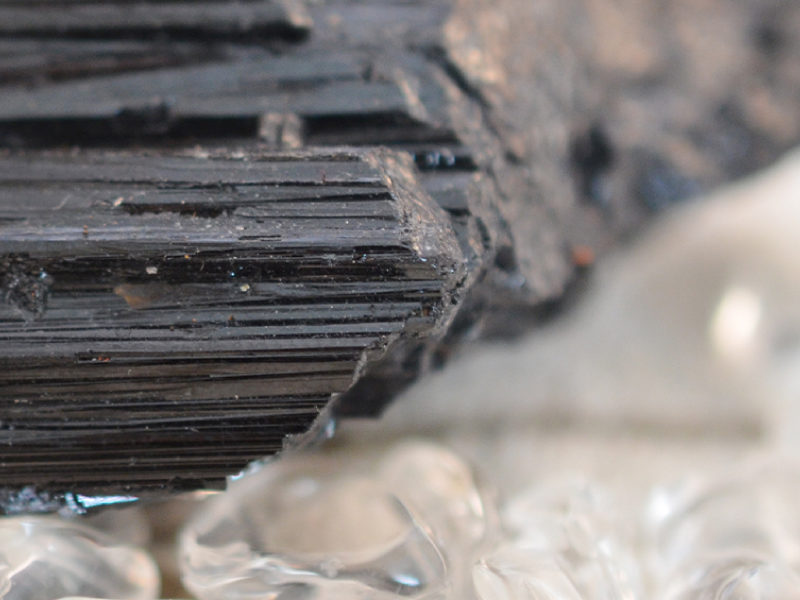
Hematite Meaning
In crystal practice hematite is known as a stone of grounding. Its weight, coolness and iron content are said to anchor you to the earth, pulling attention out of a racing mind and back into the body. Its mirror-like surface is also linked to reflection and protection, the idea of bouncing negativity back where it came from.
Hematite Healing Properties
Grounding and Presence
This is hematite’s signature. People who feel spacey, distracted or “up in their head” often carry it. Holding something heavy and cool while you breathe slowly is a well-known grounding technique, so this one has a very practical side. Pair it with our list of calming crystals.
Focus and Mental Organisation
Hematite is traditionally used to help organise thoughts and stay on task, which makes it a popular stone for studying and focus.
Protection
Its reflective surface is said to deflect negative energy. Many practitioners combine it with black tourmaline and black obsidian, the other heavy hitters in our protection crystals guide.
Strength and Courage
Given its ties to Mars and warriors, hematite is believed to support willpower, stamina and the courage to follow through, especially when you are tired or discouraged.
Boundaries
Sensitive people often use hematite as a symbolic shield, a reminder that other people’s moods do not have to become their own.
What About Blood and Circulation?
Because hematite is rich in iron and named after blood, many sites claim it improves circulation or treats anaemia. There is no scientific evidence that holding or wearing hematite does either; your body cannot absorb iron from a stone through your skin. If you are concerned about iron levels or circulation, please talk to a doctor.
Hematite and the Root Chakra
Hematite is one of the classic root chakra stones. The root chakra sits at the base of the spine and is associated with safety, stability and belonging. When it is said to be out of balance, people describe feeling anxious, ungrounded or insecure. Placing hematite at the base of the spine or by your feet during meditation is the traditional way to work with it. See also how to heal your chakras with crystals.
The Truth About Magnetic Hematite
Most shiny, strongly magnetic “hematite” bracelets are not natural hematite at all. Natural hematite is only very weakly magnetic: it will not snap onto a fridge or pull on a magnet. The strongly magnetic material is usually a synthetic ceramic, often a barium or strontium ferrite, sold as “magnetic hematite”, “hematine” or “haematite”.
That does not make it bad. It is attractive, affordable and fine as a grounding reminder. But know what you are buying, and note that claims about magnetic jewellery relieving pain have not held up well in clinical trials. People with pacemakers or other implanted devices should avoid strong magnets altogether.
How to Tell Natural Hematite
- Streak test: natural hematite leaves a reddish-brown streak on unglazed porcelain.
- Magnet test: if it grabs a magnet strongly, it is almost certainly synthetic.
- Weight: real hematite is noticeably heavy for its size.
- Price and uniformity: perfectly identical beads at very low prices are usually synthetic.

How to Use Hematite
- Carry a tumbled stone and hold it when you feel scattered. A pack of natural hematite tumbled stones is inexpensive.
- Hold one in each hand during a five-minute breathing break.
- Place it under your desk or by your feet while working.
- Keep it by the front door as a symbolic protective stone.
- Wear it as a bracelet or ring, especially on busy or high-pressure days. A simple hematite ring is an easy everyday option.
- Use it at bedtime if a busy mind keeps you up; some people hold it while they unwind.
A 5-Minute Hematite Grounding Practice
- Sit or stand with your feet flat on the floor.
- Hold a piece of hematite in each hand, or one in your dominant hand.
- Notice its weight and coolness. Let your shoulders drop.
- Breathe in for four counts and out for six, five times.
- Picture roots growing from your feet into the ground, steady and strong.
- Name five things you can see, four you can hear, and three you can feel.
- Finish with: “I am here. I am steady.”
This blends a crystal ritual with the well-known 5-4-3-2-1 grounding exercise, which is a genuinely useful tool for pulling attention back to the present.
Hematite Crystal Pairings
- Hematite + smoky quartz: deep grounding and stress release.
- Hematite + clear quartz: grounded clarity.
- Hematite + red jasper: stamina and steady motivation.
- Hematite + amethyst: calm, especially at night.
- Hematite + tiger’s eye: courage and focus.
Hematite and the Zodiac
Hematite is most often linked with Aries, the fiery Mars-ruled sign that benefits from grounding, and Aquarius, whose big ideas need an anchor. It is also suggested for Capricorn for steady ambition.
Caring for Hematite
- Keep it dry. Prolonged water exposure can cause rust-coloured spotting on the surface. Wipe it with a dry or barely damp cloth.
- Avoid salt for cleansing.
- Handle with care. Hematite is fairly brittle and can chip or shatter if dropped on a hard floor.
- Cleanse energetically with smoke, sound, moonlight or a selenite plate. See our crystal cleansing guide.
- A note on breaking: popular belief says hematite breaks when it has absorbed too much negativity. Practically, it is brittle and was probably knocked.
Frequently Asked Questions
What is hematite good for spiritually?
Hematite is traditionally used for grounding, focus, protection and strength. It is a root chakra stone believed to anchor scattered energy.
Can hematite go in water?
No. Avoid soaking or rinsing it; water can leave rust-coloured marks. Cleanse it with smoke, sound or moonlight instead.
Is hematite magnetic?
Natural hematite is only very weakly magnetic. Strongly magnetic “hematite” jewellery is usually a synthetic ferrite.
Why did my hematite break?
Folklore says it absorbed negative energy. In reality hematite is brittle and easily cracks from a knock or drop.
Can I sleep with hematite?
Many people keep it on the nightstand for grounding. Some find it too stimulating for sleep and prefer amethyst or howlite; see what works for you.
Who should not wear hematite?
There are no known risks from natural hematite. Anyone with a pacemaker or implanted device should avoid strongly magnetic jewellery, and no stone should replace medical treatment.
Which hand should I wear a hematite bracelet on?
Tradition says the left hand to receive grounding energy and the right to release tension. Wear it where it feels comfortable.
This article shares traditional, cultural and spiritual beliefs about hematite for general interest only. Crystals are not a substitute for medical advice, and magnetic jewellery should not be worn by people with pacemakers or other implanted devices. Please consult a qualified professional for any health concern.