
Smoky quartz is the grounding stone of the quartz family — translucent brown to near-black, unglamorous next to amethyst, and quietly the one most people end up reaching for. In crystal tradition it is known as the stone that takes the edge off: the one you hold when your head is loud, your day has been heavy, or you need to feel your feet again.

Smoky Quartz Meaning At A Glance
- Meaning: grounding, protection, releasing what you no longer need
- Chakra: root, with some traditions adding the solar plexus
- Element: earth
- Zodiac: Scorpio, Sagittarius, Capricorn
- Hardness: 7 on the Mohs scale — durable, water-safe
- Colour range: pale champagne through cognac to opaque morion black
- Best for: stress, overthinking, protective work, transitions and letting go
What Is Smoky Quartz?
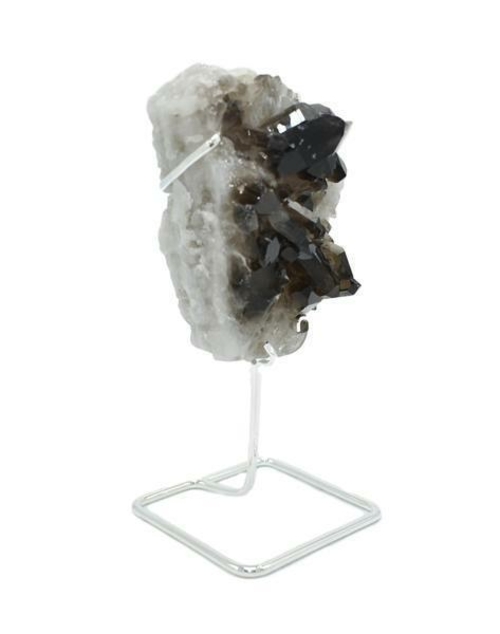
Smoky quartz is macrocrystalline quartz — the same silicon dioxide as clear quartz and amethyst — that has taken on a brown or grey tone from natural irradiation acting on trace aluminium in its structure. That is why it forms in granite country: Brazil, Madagascar, Switzerland and the Scottish Highlands, where the darkest variety, cairngorm, was traditionally set into Highland dress.
It grows as points, clusters, tumbled pebbles and carved shapes, and the colour can range from a barely-there smoky wash to the completely opaque black known as morion. Be aware that a lot of very cheap, uniformly dark “smoky quartz” on the market is clear quartz that has been artificially irradiated to a flat, slightly grey-black colour — natural material almost always shows some variation and translucency at the edges.

Smoky Quartz Meaning And Symbolism
Where clear quartz is traditionally described as amplifying and amethyst as elevating, smoky quartz is the stone of coming back down. Its symbolism is about transmutation — the belief that heavy or unwanted energy can be drawn in and neutralised rather than simply pushed away.
Historically the stone carried associations with the earth and with mourning. Cairngorm smoky quartz appeared in Scottish brooches and dirk handles; in the Victorian era darker quartz was cut for mourning jewellery. In Tibetan tradition quartz in general was regarded as sacred, and darker stones were linked with grounding spiritual experience back into the body.
That thread runs through modern crystal practice too. Smoky quartz is the stone people are handed when life is unsettled and the goal is not transformation but steadiness.
Smoky Quartz Healing Properties
Emotional Grounding
Smoky quartz is most often used for the fog of low-grade stress: the mind that will not stop rehearsing conversations, the tension that sits in the shoulders after a long week. It is said to draw off that surplus and return you to the present. For anxious spirals in particular it is commonly paired with the stones in our guide to calming crystals for anxiety.
Letting Go
Because its traditional role is release rather than attraction, smoky quartz features heavily in endings — a job you have outgrown, a habit, a relationship, a grief you have been carrying. It appears in most crystal work around grief and again in new beginnings, since the two are usually the same doorway.

Protection
Smoky quartz is one of the classic protective stones, though it is described as gentler than black obsidian and less of a hard wall than black tourmaline. Traditionally it is placed near a front door, a desk, or a bedside to absorb rather than repel. Our guide to crystals for protection compares the options.
Physical Associations
In traditional lore smoky quartz is linked to the lower body, physical stamina and recovery after exertion, and is often described as helping people who feel disconnected from their body. These are beliefs from crystal tradition, not medical findings, and nothing here should replace care from a doctor.
Spiritual Work
Smoky quartz is used to close a practice as much as open one. After meditation, energy work or a long ritual it is traditionally held to bring awareness back down — a useful counterweight if meditating with crystals leaves you spacey.
Smoky Quartz And The Root Chakra
Smoky quartz belongs to the root chakra, the base of the spine, which governs safety, belonging and the sense of having somewhere solid to stand. When that centre feels unsteady, the traditional signs are restlessness, financial anxiety and difficulty settling. Placing smoky quartz at the base of the spine or between the feet during a lie-down is the standard practice — see root chakra stones and how to heal your chakras with crystals.
Some practitioners extend it to the solar plexus for personal power and boundaries. If you are laying a full set, what order chakra stones go in covers the sequence.
Smoky Quartz Crystal Pairings
- Smoky quartz + amethyst: the classic evening pair — calm the mind, ground the body.
- Smoky quartz + rose quartz: for heartbreak and grief, softness alongside stability.
- Smoky quartz + citrine: release the old, invite the new. Common in new moon work.
- Smoky quartz + selenite: clearing plus grounding, the standard reset combination.
- Smoky quartz + tiger’s eye: steady focus for work and long projects.
- Smoky quartz + fluorite: for study — organised thinking without the jitter.
How To Use Smoky Quartz
- Hold it when you are overwhelmed. Hold a smoky quartz palm stone in both hands, five slow breaths, feet flat on the floor. This is the whole practice for most people.
- Wear it. A smoky quartz pendant or bracelet keeps a grounding stone with you through a difficult day.
- Place it by the front door or wherever the day arrives — traditionally to absorb what you bring home.
- Keep it at the desk to filter the static of other people’s urgency; it appears in most lists of crystals for your workspace.
- Use it at the bedside if your mind races at night. Unlike citrine, it is considered a restful stone.
- Anchor a grid with it. Four smoky quartz points at the corners hold the boundary of a layout — see our crystal grid guide.
- Close a release ritual with it. Name what you are putting down, hold the stone while you say it, then cleanse the stone afterwards.
Smoky Quartz And The Zodiac
Smoky quartz is traditionally associated with Scorpio for its work with shadow and transformation, Sagittarius for grounding restless fire, and Capricorn as an earth-sign stone of endurance. It is also a common recommendation during Mercury retrograde, when the advice is to steady rather than push.
Caring For Smoky Quartz
At Mohs 7 smoky quartz is one of the easier stones to look after. Water is fine, so a brief rinse under cool running water is the simplest cleanse, followed by smoke, sound or a night on selenite. Full options are in how to cleanse your crystals.
The one real caution is sunlight: prolonged direct sun fades smoky quartz toward grey or clear, exactly as it does with amethyst and citrine. Charge it in moonlight instead — full moon rituals and crystals for moon phases cover the timing. Because it is traditionally believed to absorb rather than deflect, protective smoky quartz is usually cleansed more often than other stones: monthly, or after any especially heavy week.
How To Spot Fake Smoky Quartz
- Flat, even blackness with no translucency at thin edges usually means irradiated clear quartz rather than natural material.
- Perfect clarity with perfect colour at a very low price is a warning sign, particularly in faceted beads.
- Warm to the touch instantly — real quartz stays cool for a few seconds. Glass does not.
- Bubbles inside are glass. Natural quartz has veils, fractures and needle inclusions, not round bubbles.
- Buy from sellers who name the origin. Our page on where to buy healing crystals explains what to ask.

Frequently Asked Questions
What is smoky quartz good for?
Grounding, stress relief, protection and letting go. It is the stone most often suggested for overthinking, difficult transitions and the tail end of a hard week.
Can smoky quartz go in water?
Yes. At Mohs 7 with no water-soluble components it tolerates a rinse comfortably. Avoid hot water and harsh cleaners, and do not leave wire-wrapped pieces soaking, as the metal will tarnish.
Can smoky quartz go in the sun?
Briefly, but not as a habit. Its colour comes from irradiated aluminium centres that UV light reverses over time, so long sun exposure fades it. Moonlight is the traditional charge.
Where should I put smoky quartz in my home?
By the entrance, at the desk, or on the bedside table are the three traditional placements. For whole-home use, four pieces in the corners of a room is the standard layout — see 9 ways to remove negative energy from your home.
Is smoky quartz the same as black tourmaline?
No. Both are protective stones, but they are different minerals with different reputations: black tourmaline is described as deflecting, smoky quartz as absorbing and transmuting. Many people keep both.
Can you sleep with smoky quartz?
Yes, and it is a common choice for restless sleepers because it is grounding rather than stimulating. Put it on the nightstand rather than under the pillow if you wake up feeling heavy — see crystals for sleep.
Is smoky quartz good for beginners?
It is one of the best starting stones: inexpensive, durable, easy to cleanse and immediately useful. Most starter sets include it, and it appears in our list for crystals for beginners.
Bringing It Together
Smoky quartz is the least showy stone in most collections and often the most used. It asks nothing complicated of you: hold it, breathe, put down what you have been carrying around all day. Pair it with amethyst at night, rose quartz through grief, citrine when a chapter turns. And if it is your first stone, our guides to how to use healing crystals and how to start a crystal collection will show you what to do next.
This article is for informational and spiritual purposes only. Crystal healing is a traditional and spiritual practice, not a medical treatment, and it is not a substitute for professional medical or mental health care.