
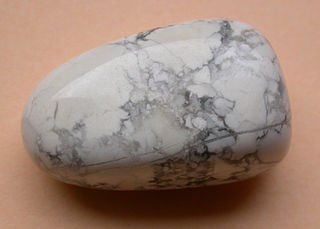
Howlite is the quiet one. No dramatic colour, no flash — just chalky white marbled with grey veins, like a small piece of stone weather. It is also one of the most widely owned crystals in the world, partly because it is inexpensive, partly because it is the stone everyone recommends for a mind that will not switch off.
This guide covers what howlite actually is, what it is traditionally said to do, how to tell real howlite from the dyed blue version sold as turquoise, and how to care for a stone soft enough to scratch with a coin.
Howlite at a glance
- Colour: white to cream with grey or black web-like veining
- Mineral: a calcium borosilicate hydroxide — a borate mineral, not a quartz
- Hardness: 3.5 on the Mohs scale — soft and porous
- Chakras: crown, with a secondary link to the third eye
- Said to support: calm, patience, sleep, cooling anger, quieting mental chatter
- Zodiac: traditionally associated with Gemini
- Water: avoid soaking — porous and soft
- Also sold as: “white turquoise” or “white buffalo stone” (see the buying section below)
What is howlite?
Howlite was first described in 1868 by Henry How, a Nova Scotian chemist and geologist, who was shown an unfamiliar white mineral by miners working a gypsum quarry — it was blunting their tools. He analysed it, and the mineral was later named after him.
Chemically it is a hydrous calcium borosilicate, one of the borate minerals, and it forms in nodules in evaporite deposits — the mineral beds left behind as ancient seas dried out. Those nodules are what give howlite its signature look: a pale body threaded with darker veins of host rock.
Most howlite on the market comes from Nova Scotia and from California, where large deposits sit alongside borax mining. Because it is soft, porous, and abundant, it is carved, tumbled, and dyed more than almost any other stone.
Howlite meaning and symbolism
Howlite is modern in crystal terms — it has no ancient mythology attached, because it was only identified in the nineteenth century. Its reputation was built in twentieth-century crystal practice, where it became known as a stone of patience and stillness: the one you reach for when the problem is not a lack of energy but an excess of it.
Practitioners describe it as cooling. Where carnelian is said to light a fire, howlite is said to damp one down — particularly the fire of anger, rumination, and the 3am replay of a conversation. That association with a quiet mind is why it appears in almost every list of sleep stones.
Howlite healing properties
Emotional: cooling anger and impatience
The best-known traditional use for howlite is anger. It is said to absorb heat from a situation and give you the pause between a feeling and a reaction — which is why some practitioners suggest holding a piece when you notice irritation rising, rather than after you have already said the thing.
It is also linked with patience in the longer sense: waiting out a slow process, sitting with an outcome you cannot control, tolerating your own progress being unglamorous.
Mental: quieting the overthinking mind
Howlite is said to slow mental chatter and make space for one thought at a time. That makes it a common pairing with study and planning stones — not to sharpen focus the way fluorite is said to, but to clear the noise underneath it.
Sleep and dreams
Placed under a pillow or on a bedside table, howlite is traditionally used for insomnia caused by a busy mind, and some practitioners also associate it with clearer dream recall. It appears alongside amethyst and lepidolite in most crystals for sleep arrangements.
Spiritual: crown chakra and stillness
White stones are generally linked with the crown chakra, the seat of connection and higher awareness in chakra tradition, and howlite is no exception. It is used in meditation to settle the mind before deeper work — see our guide to crown chakra crystals for the wider set.
Crystal healing is a traditional practice, not a medical treatment. Nothing here is intended to diagnose, treat, or replace professional care. If you have persistent insomnia, anxiety, or anger that is affecting your life, please talk to a doctor.
Howlite and the chakras
- Crown (Sahasrara): howlite’s main association — stillness, perspective, the quiet at the top of the system. Place it above the head while lying down.
- Third eye (Ajna): a secondary link, used for calming an overactive imagination rather than stimulating it.
- Root, indirectly: some practitioners use howlite with a grounding stone such as black tourmaline so the calm has somewhere to land.
If chakras are new to you, start with the seven chakras explained and how to heal chakras with crystals.
7 ways to use howlite
- Under the pillow or on the nightstand. The classic use. A tumbled piece is enough — and it is soft, so a pillowcase pocket is kinder than loose under your head.
- In your pocket on a short-fuse day. Hold it when you feel the heat rise; the physical pause is half the practice.
- In meditation. Rest it in the palm or above the crown while you settle. See meditating with crystals.
- As a worry stone. Howlite takes a beautiful smooth polish and makes a natural palm or worry stone.
- As jewellery. Howlite bracelets are common and cheap; just keep them away from perfume and the shower.
- In a calm grid. Howlite at the points, amethyst in the centre — instructions in our crystal grid guide.
- As a canvas for intention. Its blankness is the point: many practitioners program howlite with a single word for the week. See intention setting with crystals.
Crystal pairings for howlite
- Howlite + amethyst: the standard sleep duo — quiet mind plus soothing calm.
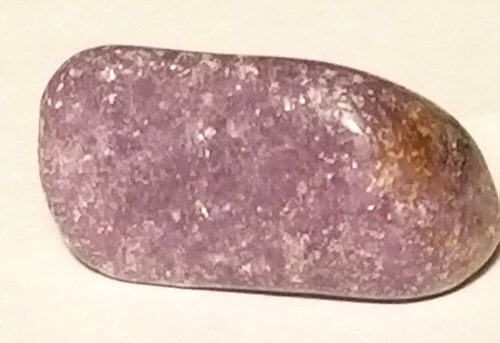
- Howlite + lepidolite: both are traditionally used for anxious, looping thoughts; lepidolite adds a softer, more emotional note.
- Howlite + black tourmaline: calm with grounding, so you feel settled rather than floaty.
- Howlite + rose quartz: for anger inside a close relationship — cool the heat, keep the tenderness.
- Howlite + clear quartz: quartz is said to amplify whatever it sits with, including stillness.
- Howlite + selenite: two white crown-chakra stones; selenite also doubles as the cleansing plate howlite prefers.
Howlite vs turquoise: the dyed stone problem

This is the single most useful thing to know about howlite. Because it is white and porous, howlite takes dye readily — and dyed blue howlite is the most common turquoise imitation in the world. It is sold honestly as “dyed howlite” by good sellers and dishonestly as “turquoise” or “turquenite” by bad ones.
How to tell the difference:
- Price. Genuine turquoise is not a few dollars a bead. If it is cheap and vividly blue, assume dyed howlite.
- Veining. Howlite’s veins are web-like and often darker grey-black; turquoise matrix tends to be browner and more irregular.
- Hardness. Howlite is 3.5 and scratches easily; turquoise is 5–6.
- Colour in the drill hole. On dyed beads, the inside of the hole is often paler than the surface — a giveaway.
- Uniformity. Dyed stones in a strand are usually suspiciously identical in tone.
Dyed howlite is not a scam in itself — it is attractive and affordable. The problem is only ever the label. The same caution applies to “white turquoise” and “white buffalo stone”, names that are sometimes used for plain howlite. Our guide to where to buy healing crystals covers sellers who describe stock properly.
How to cleanse and care for howlite
Howlite is soft (3.5) and porous, which makes it one of the more fragile common crystals. Treat it gently:
- No soaking. Brief contact with water will not destroy it, but porous stone absorbs moisture and can dull or stain. Wipe with a dry or barely damp cloth.
- No salt. Salt is abrasive and gets into the pores.
- No harsh sun. Prolonged sunlight can fade dyed pieces badly and is unnecessary for natural ones.
- Cleanse with smoke, sound, moonlight, or selenite. Full options in how to cleanse your crystals, including methods without palo santo.
- Store separately. Harder stones will scratch it in a shared pouch.
Frequently asked questions
What is howlite good for?
It is traditionally used for calm: cooling anger, easing impatience, quieting an overactive mind, and helping with sleep. It is a crown chakra stone and one of the most common beginner crystals.
Can howlite go in water?
Do not soak it. Howlite is soft and porous, so water can dull the polish, seep in, and lift dye from coloured pieces. Cleanse it with smoke, sound, moonlight, or a selenite plate instead.
Is howlite the same as turquoise?
No. Howlite is a white borate mineral; turquoise is a copper aluminium phosphate. Dyed blue howlite is widely sold as fake turquoise, which is why the two get confused.
Is blue howlite real?
Blue howlite is real howlite, but the colour is not. Natural howlite is white to cream with grey veining — any blue piece has been dyed.
Where should I put howlite in my bedroom?
On the nightstand or tucked into the pillowcase. Many people pair it with amethyst; see our crystals for sleep guide for a full bedside arrangement.
Is howlite good for anxiety?
It is one of the stones most often chosen for anxious, racing thoughts, alongside amethyst and lepidolite — see calming crystals for anxiety. It is a supportive ritual, not a treatment; persistent anxiety deserves professional help.
What zodiac sign is howlite for?
Gemini, traditionally — the quick, talkative, mentally busy sign is said to benefit most from a stone of stillness.
How much should howlite cost?
Very little. Tumbled howlite is one of the cheapest stones available, usually a couple of dollars a piece. If you are being charged turquoise prices, something is wrong.
Is howlite worth having?
For a few dollars, howlite gives you the most useful thing a starter crystal can: a small, smooth object that means “slow down”. Keep one by the bed and one in a coat pocket, and you have covered the two moments most people need it.
If you are still building your collection, read how to start a crystal collection next, or browse our top 10 healing crystals for the essentials worth owning first.
Howlite is also a reminder that a crystal does not have to be spectacular to be useful. Sometimes the plain white stone in your pocket is the one you actually reach for.